
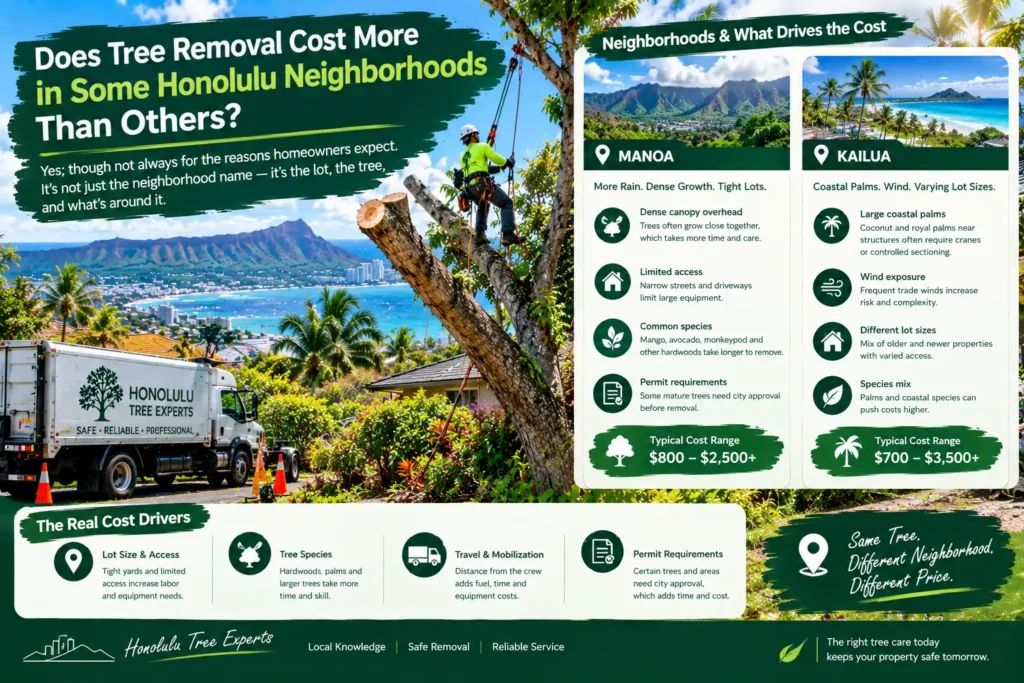
Yes; though not always for the reasons homeowners expect. Most of what drives the difference isn’t the neighborhood name – it’s the lot, the tree, and what’s around it. A tight Manoa property with a mature monkeypod is a different job than an open Pearl City lot with the same species. The neighborhood shapes those conditions more than most homeowners realize.
Tree removal cost in Honolulu shifts by neighborhood because of how lots are configured, what species dominate each area, and what access the crew has to work with. Manoa’s dense tropical growth on small lots creates access challenges that don’t exist in Pearl City. Kailua’s coastal palms near structures push jobs toward crane or controlled sectioning. These differences show up in quotes from tree removal contractors in Honolulu — the same size tree in different locations is genuinely a different job.
What Actually Drives Cost Differences Between Neighborhoods
Before getting into specific neighborhoods, understanding what actually creates cost variation makes the neighborhood-specific information more useful.
Lot size and access
Tight lots in dense residential neighborhoods limit where equipment can be positioned. A large tree on a tight Manoa lot requires different equipment and more careful sectioning than the same tree on a larger Pearl City lot with open yard access. Tree removal companies in Honolulu quote based on what they see when they arrive – and access is one of the first things they evaluate.
Species mix
Manoa’s rainfall and shade grows different species than Kailua’s coastal exposure. What’s common in one neighborhood barely shows up in another. Those species don’t just look different – they cut differently, stump differently, and produce different debris volumes. Those species have different removal complexity and different stump characteristics that affect the quote.
Travel and mobilization
A crew working out of central Honolulu prices a Hawaii Kai job differently than a Manoa job. Not dramatically – but fuel, drive time, and equipment transport add something to the number. Tree removers in Honolulu factor it in whether they say so or not. Fuel, time, and equipment transport factor into pricing. This is a smaller component than the job-specific factors but it’s real — tree removers in Honolulu don’t ignore mobilization cost when setting prices.
Permit requirements
Some neighborhoods have higher concentrations of protected species or mature canopy trees in residential zones that require city approval before removal. The permitting process adds time and sometimes cost to jobs in areas where these trees are common.
Manoa: What Drives Tree Removal Cost
Manoa receives more rainfall than most Oahu neighborhoods – it sits at the base of the Ko’olau Range and collects moisture that doesn’t reach lower elevation properties. That rainfall produces dense tropical growth on relatively small residential lots.
The combination of dense growth, small lots, and older established trees creates specific cost drivers for tree removal contractors in Honolulu working in Manoa.
Dense canopy overhead
Manoa properties frequently have multiple large trees close together. Manoa properties stack trees close together. A tree coming out often has its canopy tangled with a neighbor tree that stays. Getting one out without damaging the other takes more time and more care than pulling a tree from an open yard.
Limited access
Narrow streets and tight driveways in many parts of Manoa limit where large equipment can be positioned. A crane that would solve a difficult removal on a more accessible property can’t always get to its working position in Manoa. This pushes more jobs toward rope-and-rigging sectioning that takes longer than crane removal.
Species mix
Manoa’s moisture supports aggressive tropical species — large mangoes, avocados that have grown well past their original size, and monkeypods that have had decades to establish in the deep soil. These are dense hardwood removals that take longer per foot of tree than softer species.
Removing small trees in Honolulu on Manoa properties often happens alongside larger removal jobs – the dense growth that creates access challenges for large trees also produces competing smaller trees that need clearing. Bundling multiple trees on the same visit reduces the per-tree cost in Manoa’s tight conditions.
Kailua: What Drives Tree Removal Cost
Kailua sits on Oahu’s windward coast. Properties in Kailua deal with consistent trade wind exposure, salt air, and a residential character that mixes older established lots with newer development on varying lot sizes.
Large coastal palms
Coconut palms and royal palms are more common in Kailua than in inland neighborhoods. Tall coastal palms near structures – a common situation in Kailua residential areas – require careful controlled sectioning or crane removal. Palm tree removal in Kailua runs toward the higher end of palm removal pricing because height and proximity to structures both factor in.
Salt air stress
Trees in Kailua deal with more salt air exposure than inland properties. Salt air accelerates internal decay in ways that aren’t visible from the outside – a tree that looks structurally sound can have compromised wood fiber internally. Tree removers in Honolulu working in coastal Kailua regularly encounter trees where the removal reveals more internal decay than the exterior suggested. Compromised wood creates unpredictable behavior during cutting — which adds time and care to the job.
Beach and waterfront access challenges
Properties near Kailua Beach and along canal-side streets face specific access challenges. Some lots back up to water features that limit where debris can be staged and where equipment can be positioned. Tree and limb removal in Honolulu on these properties takes longer than the same job on a more accessible inland lot.
Wind-damaged trees
Kailua’s consistent trade wind exposure means more trees show wind-related structural stress than in more sheltered neighborhoods. Trees with wind-driven lean and one-sided canopy development take more careful assessment and more controlled removal than structurally balanced trees.
Pearl City: What Drives Tree Removal Cost
Pearl City properties generally offer better access than Manoa or coastal Kailua — larger lots, wider streets, and more open yard conditions in many areas. This tends to make Pearl City jobs more straightforward than comparable jobs in tighter neighborhoods.
Large established trees
Pearl City has mature residential development with established trees that have had decades to grow. Large monkeypod and other canopy species that were appropriate when planted have sometimes outgrown their locations. Tree removal contractors in Honolulu quotes on large Pearl City trees reflect the size and density of these established species — not the access challenges that inflate Manoa or Kailua pricing.
More open access
Better access in many Pearl City neighborhoods means larger equipment can be used more frequently. A crane job in Pearl City is often more straightforward than a crane job in Manoa because the crane can reach its working position without the neighborhood access constraints.
Industrial proximity effects
Parts of Pearl City near industrial areas have different soil conditions and different tree stress patterns than purely residential neighborhoods. Trees near Pearl Harbor have dealt with specific environmental conditions over decades that sometimes show up as internal issues not visible from the exterior.
Removing small trees in Honolulu on Pearl City properties often happens as part of general property clearing – removing multiple smaller trees and overgrown growth that accumulated on larger lots. Tree service removal companies in Honolulu quotes on these jobs tend to be more straightforward in Pearl City than in tighter neighborhoods.
Kaneohe, Aiea, Hawaii Kai: Other Neighborhood Factors
Kaneohe
Similar rainfall patterns to Manoa but larger lots in many areas. Dense tropical growth with better access than central Manoa in most cases. Kaneohe properties frequently have established fruit trees — avocado, mango, citrus — that have outgrown their original planting locations. These species combine moderate-to-high wood density with root systems that have spread into hardscaping over the years.
Aiea
Central location with generally good access. Mix of older and newer development. Slope is a factor on some Aiea properties — trees on steep slopes require different removal approaches than flat lot jobs. Equipment positioning on sloped terrain adds complexity and time to jobs that would be straightforward on level ground.
Hawaii Kai
Coastal exposure is similar to Kailua in some areas. Marina-adjacent properties have specific access challenges. Higher-end properties in Hawaii Kai often involve more careful debris handling and site restoration expectations — the job isn’t just about removing the tree, it’s about leaving the property in condition consistent with the neighborhood standard. Tree removal reviews in Honolulu from Hawaii Kai homeowners consistently mention cleanup quality as a priority.
Getting Accurate Quotes by Neighborhood
A phone quote is a guess. The factors that drive neighborhood-specific cost variation — access conditions, the specific tree, what’s around it — aren’t visible from a phone conversation. Any tree removal companies in Honolulu worth hiring visits the property before quoting.
What to tell the crew when scheduling an on-site assessment:
The tree species is known. The approximate height. What’s underneath and around it — structures, vehicles, utilities, other trees. Whether the property has access constraints — narrow driveway, tight gate, slope.
This information helps the crew estimate the job scope before arriving — but it doesn’t replace the site visit. The on-site assessment is where the actual quote gets established.
For Residential Tree Service in Honolulu across different neighborhoods, comparing two or three quotes from tree removal contractors in Honolulu gives a realistic picture of the going rate for a specific job. If one quote comes in significantly below others, the question is why — not when can you start.
How to Compare Tree Removal Companies in Honolulu
Across any Honolulu neighborhood, the criteria for evaluating tree removal companies don’t change.
ISA-certified arborists on the job not just at the company. The arborist making decisions about cut sequence and approach should have ISA certification, not just the person giving the estimate.
Hawaii contractor’s license and current insurance ask for both before work starts. A tree removal contractor in Honolulu without proper insurance puts the homeowner on the hook for any damage or injury during the job.
Written quote that includes debris removal some quotes cover cutting only. A complete job covers cutting, chipping or hauling, and site clearing. Compare complete job quotes, not just cutting costs.
Tree removal reviews in Honolulu from actual local homeowners, not generic five-star ratings. Reviews that mention specific neighborhoods, specific species, and specific outcomes tell more than summary ratings.
On-site assessment before quoting any tree service removal company in Honolulu that quotes over the phone without seeing the property is guessing. A guess that changes on arrival is a problem that started with the phone quote.
FAQs Tree Removal Cost by Neighborhood in Honolulu
Q1: Does tree removal actually cost more in Manoa than in Pearl City?
Often yes, because of access conditions and species complexity. Manoa’s dense lots, narrow access, and mature hardwood species create more complex jobs than Pearl City’s generally more open conditions. The same size tree in each neighborhood can produce significantly different quotes from the same tree removal companies in Honolulu – because the job is genuinely different.
Q2: Why do coastal Kailua tree removal jobs cost more?
Salt air accelerates internal decay that isn’t visible externally, tall coastal palms near structures require controlled sectioning or crane equipment, and some coastal properties have limited access for large equipment. These factors add time and complexity to jobs that would be more straightforward on inland properties.
Q3: How do I know if a quote from tree removal contractors in Honolulu is fair for my neighborhood?
Compare two or three quotes from companies that do on-site assessments before quoting. If quotes are consistent, you have a reliable market rate for the specific job. If one quote is significantly lower, ask what it includes — debris removal, permits, stump grinding — and whether ISA-certified arborists will be on the job.
Q4: Does the same company charge different rates in different neighborhoods?
Most legitimate tree removers in Honolulu charge based on the job, not the neighborhood. A difficult job in Pearl City costs more than an easy job in Manoa — it’s the job characteristics, not the zip code, that drive pricing. Travel distance from the crew’s base adds a minor component to some quotes but isn’t typically a major factor within the Honolulu metro area.
Q5: What neighborhoods have the most expensive tree removal jobs on average?
Coastal neighborhoods, Kailua, Hawaii Kai, beachside properties, and dense urban neighborhoods with established large trees — Manoa, Nuuanu, older areas of Honolulu — tend toward higher average job costs because of the species mix, access challenges, and structural complexity of the trees involved. Open suburban neighborhoods like Pearl City and Aiea tend toward more straightforward jobs and lower average costs.
Q6: How do I get the best price on tree removal in my Honolulu neighborhood?
Schedule during non-emergency periods and avoid peak storm season demand. Bundle multiple trees on the same visit – per-tree cost drops when the crew is already on site. Add stump grinding on the same visit rather than scheduling it separately. Get written quotes from multiple licensed tree removal companies in Honolulu and compare on equal terms — same scope, same debris handling, same documentation.
Q7: Does Honolulu Tree Expert serve all Honolulu neighborhoods?
Yes. Honolulu Tree Expert handles Tree Removal Honolulu across Manoa, Kailua, Pearl City, Kaneohe, Aiea, Hawaii Kai, and all of Oahu. Every job starts with a free on-site assessment – the quote reflects what the specific property and tree actually involve, not a generic neighborhood rate. Tree removal reviews in Honolulu from homeowners across Oahu are available on request.