
Most Honolulu homeowners hiring a tree service ask whether the company has ISA-certified arborists. Most take the answer at face value. Verification takes two minutes and a phone number — and the gap between a company that actually employs certified arborists and one that claims to is wide enough to matter when something goes wrong on a property.
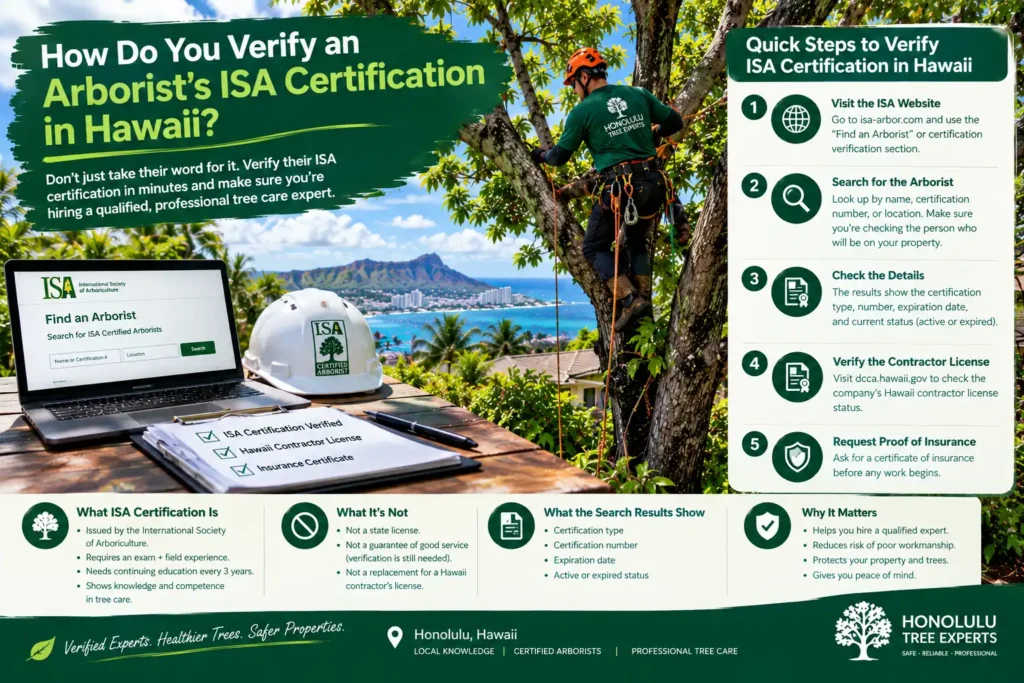
ISA certification can be verified directly through the International Society of Arboriculture’s online certification database at isa-arbor.com. Search by name or certification number — the database shows whether the certification is current and active. For Hawaii specifically, also verify the company’s contractor license through the Hawaii Department of Commerce and Consumer Affairs license search, and request a certificate of insurance before any work starts. These three checks take less than ten minutes and tell a homeowner most of what they need to know about the company they’re considering.
What ISA Certification Actually Is: And What It Isn’t
ISA certification is issued by the International Society of Arboriculture — the global professional body for tree care. Getting certified requires passing a written exam covering tree biology, risk assessment, pruning technique, and soil science. Field experience is required before anyone can sit the exam — it’s not a course completion certificate.
Keeping the certification requires continuing education every three years. An arborist who passed the exam five years ago but hasn’t completed continuing education doesn’t have a current certification — they have a lapsed one. The ISA database shows current status, not just whether someone passed the exam at some point.
What ISA certification isn’t: a license to operate as a tree service in Hawaii. Hawaii has its own contractor licensing system through the Department of Commerce and Consumer Affairs. ISA certification is a professional credential — it indicates knowledge and competence. A Hawaii contractor’s license is a legal requirement — it indicates the company has met the state’s requirements to operate. The best tree service in Honolulu carries both.
The difference between an ISA-certified arborist and someone without certification isn’t just a credential on a wall. It’s the difference between someone who understands how trees fail and how to bring them down safely, and someone who knows which end of a chainsaw to hold. That difference shows up in how a job is assessed, how cuts are sequenced, and what decisions get made when the tree reveals something unexpected during removal.
How to Search the ISA Certification Database
The ISA maintains a public certification database at isa-arbor.com. The search function is free and requires no account.
Go to isa-arbor.com and navigate to the “Find an Arborist” or certification verification section. The database can be searched by name, certification number, or location.
Search by the arborist’s name — the person who will actually be on the job, not just the company owner. Some tree service companies employ one certified arborist for assessments and send uncertified crews to do the work. Ask specifically who will be on the property and verify that person’s certification.
The search result shows: the arborist’s name, certification number, certification type, and whether the certification is currently active or expired. An active certification means the arborist has completed their continuing education requirements and is current. An expired certification means they haven’t — and an expired certification provides none of the assurance of an active one.
A tree service honolulu company that encourages verification and provides certification numbers upfront is operating with confidence in its credentials. A company that deflects, provides vague answers about certification, or claims the database is hard to use is worth treating with skepticism.
What the Search Results Show
The ISA database returns specific information for each certified arborist:
Certification type: ISA offers several credential levels. Certified Arborist is the baseline. ISA also offers Certified Arborist Municipal Specialist, Utility Specialist, and Board Certified Master Arborist at advanced levels. For residential and commercial tree work in Honolulu, Certified Arborist is the relevant credential.
Certification number: a unique identifier for each certified arborist. If a company gives you a certification number and the name doesn’t match in the database, that’s a significant red flag.
Expiration date: certifications run on a three-year renewal cycle. A certification expiring in the current year isn’t necessarily a problem — but it’s worth asking whether renewal is in progress.
Active or expired status: the clearest indicator. Active means current and valid. Expired means the arborist hasn’t completed their continuing education and the credential isn’t current.
An affordable tree service in Honolulu that also carries active ISA certification for its arborists is providing real value. A cheap quote from a company whose certification search returns expired results or no results is a price that doesn’t account for the risk the homeowner is accepting.
Hawaii Contractor License Verification
ISA certification is a professional credential. A Hawaii contractor’s license is a legal requirement for operating as a tree service company in the state.
The Hawaii Department of Commerce and Consumer Affairs maintains a public contractor license database. Go to dcca.hawaii.gov and search the contractor license database by company name or license number.
The search shows: license number, license type, license holder name, license status, and expiration date. Active means the company is currently licensed to operate. Expired or inactive means it isn’t.
A C-27 license is the Hawaii contractor classification covering landscaping — which includes tree work. Some tree services hold other contractor classifications depending on their scope of work. The relevant check is whether the license is active and the company is currently licensed to do tree work in Hawaii.
Cutter tree service in Honolulu operations that aren’t properly licensed don’t just create risk during the job — they create legal exposure for the homeowner if a claim arises from work done by an unlicensed contractor. Hawaii has specific provisions around unlicensed contractor work that can affect insurance claims and property liability.
Insurance Verification
A Hawaii contractor’s license confirms the company is legally permitted to operate. Insurance confirms the homeowner is protected if something goes wrong during the job.
Two types of insurance matter for tree work in Honolulu:
General liability insurance covers property damage during the job. A tree that damages a fence, vehicle, or structure during removal — a crew without liability insurance leaves the repair cost on the homeowner. Ask for a certificate of insurance before work starts. The certificate shows the insurance company, policy number, coverage limits, and policy period. A current certificate from a recognizable insurer is what to look for.
Workers’ compensation covers crew injuries on the property. A crew member injured during tree work without workers’ compensation coverage may have a claim against the homeowner’s property insurance. This is the coverage most homeowners don’t think to ask about. Ask specifically whether the crew has workers’ compensation — not just liability insurance.
Honolulu tree service companies that resist providing insurance documentation before work starts are companies worth walking away from. A legitimate operation provides certificates without hesitation because they carry coverage as a matter of standard business practice.
Red Flags That Suggest Certification Claims Aren’t Accurate
Resistance to providing certification numbers
A company that says “yes, we’re ISA certified” but won’t provide the certification number of the arborist who will be on the job has something to hide. Certification numbers are public — there’s no reason not to provide them.
Certification that doesn’t match the database
A name provided as the certified arborist that returns no results in the ISA database, or returns an expired certification, is a direct contradiction of the company’s claim. This isn’t a minor discrepancy — it means the company misrepresented its credentials.
“We have ISA-certified staff” without specifics
Employing one certified arborist somewhere in the company while sending uncertified crews to do the work is a common way to technically claim certification without actually delivering it. Ask who specifically will be on the job and verify that person’s certification.
Reluctance to do an on-site assessment
ISA-certified arborists assess before they cut. A company that quotes over the phone and sends a crew without an arborist visit isn’t operating the way a certified operation operates. Tree service in Honolulu that starts with a phone quote and a crew showing up without a prior assessment isn’t putting its certified knowledge to work on the property.
No written documentation
ISA-certified operations produce written assessment reports, not verbal recommendations. A company that won’t put its assessment and quote in writing isn’t operating with the accountability that certification implies.
Why Verification Matters Specifically in Honolulu
Hawaii has specific tree conditions that make the knowledge behind ISA certification practically relevant — not just a credential formality.
Coconut Rhinoceros Beetle management requires understanding how beetle pressure spreads through palm material handling. An arborist who knows the species-specific risk makes different decisions about debris handling than one who doesn’t.
Hawaii’s Urban Forestry permit requirements involve protected species and zone-specific rules. An ISA-certified arborist working in Honolulu knows which trees trigger permit requirements before the job starts — not after the tree is on the ground.
Oahu’s volcanic soil creates root system behavior that affects how trees are assessed for stability and how removal is sequenced. An arborist trained in tree risk assessment understands saturated volcanic soil root behavior in ways that inform every stability assessment on the island.
Fusarium wilt in Canary Island date palms, Phytophthora root rot in the wet conditions of properties like Manoa — these disease patterns are Hawaii-specific and require local knowledge to identify correctly. An ISA-certified arborist who has worked Oahu properties knows what to look for. A crew without that background misses what’s visible if you know where to look.
Cutters tree service in Honolulu operations that have been working Oahu properties for years develop this local knowledge on top of their ISA foundation. The credential provides the baseline. Local experience builds on it. Residential Tree Service in Honolulu that combines both is what a homeowner gets when they hire a certified company that’s been working the island.
FAQs ISA Certification Verification in Hawaii
Q1: How do I verify an arborist’s ISA certification in Hawaii?
Go to isa-arbor.com and search the certification database by the arborist’s name or certification number. The database shows whether the certification is currently active. Also verify the company’s Hawaii contractor’s license through the DCCA license database at dcca.hawaii.gov, and request a certificate of insurance before work starts.
Q2: What’s the difference between ISA certification and a Hawaii contractor’s license?
ISA certification is a professional credential — it confirms the arborist has passed the ISA exam and maintains continuing education. A Hawaii contractor’s license is a legal requirement — it confirms the company is permitted to operate as a contractor in the state. A legitimate tree service Honolulu operation carries both. Neither replaces the other.
Q3: Can a company claim ISA certification if only one employee has it?
Yes, and some do. The relevant question isn’t whether anyone at the company holds certification, but whether an ISA-certified arborist will be on your property making the assessment and job decisions. Ask specifically who will be on the job and verify that person’s certification in the ISA database.
Q4: What does an expired ISA certification mean?
It means the arborist hasn’t completed their continuing education requirements for the current renewal cycle. An expired certification provides none of the assurance of an active one — the arborist’s knowledge may be current, but their credential isn’t. An affordable tree service in Honolulu with expired certifications is operating on credentials it hasn’t maintained.
Q5: Does ISA certification guarantee good work on my Honolulu property?
It significantly increases the probability of professional assessment and execution. An ISA-certified arborist understands tree biology, risk assessment, and proper pruning and removal technique. That knowledge changes how jobs are assessed and executed. It doesn’t guarantee a perfect outcome — but the gap between certified and uncertified operations on complex Oahu tree jobs is real and consistent.
Q6: What should I do if a company’s certification claim doesn’t check out?
Don’t hire them for the job. A company that misrepresents its credentials in the verification process isn’t a company that operates honestly when problems arise during or after the job. Best tree service in Honolulu companies that carry real credentials provide them readily — there’s no reason to misrepresent when the credentials are real.
Q7: Does Honolulu Tree Expert’s ISA certification check out in the database?
Yes. Honolulu Tree Expert employs ISA-certified arborists on every job. Certification numbers are available on request before any work is scheduled. The tree services honolulu hi homeowners can verify: isa-arbor.com search returns active certifications for the arborists who will be on the property. Commercial Tree Service in Honolulu, residential work, emergency response — certified arborists on every visit.