
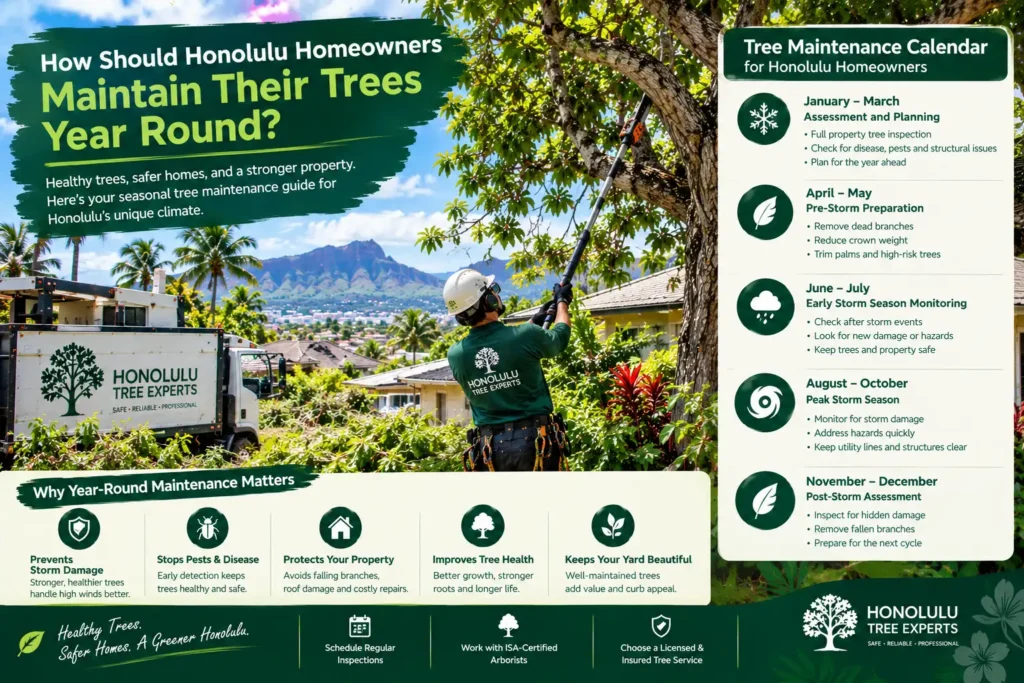
Honolulu’s trees don’t get a break. Warm temperatures, year-round humidity, and a storm season that runs half the year mean trees on Oahu properties are actively growing, actively facing disease pressure, and actively getting tested by weather in every month of the calendar. A maintenance schedule built around Honolulu’s actual conditions – not a generic mainland schedule keeps that growth manageable and catches problems before they become emergencies.
Honolulu tree maintenance runs on two parallel tracks – a storm season preparation cycle and a year-round health and growth management cycle. Pre-storm pruning and dead branch removal happen in April and May before peak storm activity. Post-storm assessment happens in November and December after the season winds down. Health checks, trimming for growth management, and pest and disease monitoring run throughout the year on a species-specific schedule. A tree care company in Honolulu on a regular maintenance program handles both tracks rather than treating each visit as a one-off job.
January to March: Assessment and Planning
January through March is Honolulu’s quietest period for storm activity. Trade winds are consistent, rainfall is lower than peak season, and trees are in a relatively stable growth phase compared to the rapid pace they’ll hit once conditions warm further into spring.
This window is the right time for a full property assessment — not a pre-storm pruning visit, but a baseline evaluation of every tree on the property. What’s the condition going into the year? Which trees developed new structural issues since the last assessment? And Which palms are showing early Coconut Rhinoceros Beetle signs? Which trees have root systems approaching infrastructure?
Tree care in Honolulu that starts with a January or February assessment gives the homeowner a clear picture of what needs to happen before storm season arrives — and enough time to schedule removal of high-risk trees, address disease, and plan pruning work without rushing it into the narrow window before peak storm months.
This is also the right window for tree planting services in Honolulu. New trees planted in the first quarter have months to establish root systems before storm season puts them under stress. A tree plant in September or October is going into its first Honolulu storm season with a root system that’s barely establish – a tree plant in February has six months of growth before that same test arrives.
Species selection and placement decisions made in this window have decade-long consequences. Getting the right tree in the right spot, at the right distance from foundations, driveways, and utility lines, is a decision that a tree care company in Honolulu with ISA-certified arborists can advise on specifically – not a general planting guide written for mainland conditions.
April to May: Pre-Storm Preparation
April and May are the most important months on the Honolulu tree maintenance calendar. Storm season officially opens in June — pre-storm pruning done in April and May goes in before the highest-risk period rather than scrambling to catch up after it starts.
What happens in this window:
Dead branch removal. Dead upper canopy branches — widow makers — come out before storm winds give them a reason to fall. A crew controls where they go. A storm doesn’t.
Crown weight reduction on large canopy species. Monkeypod, mango, and avocado that have added significant canopy weight since the previous pruning get thinned. The crown going into storm season carries less load against the root system.
Palm frond management. Dead fronds come off. Live frond loads get reduced on species where thinning makes sense. A palm going into storm season with two seasons of untrimmed growth is a higher risk than one that was managed in April.
High-risk tree removal. Any tree identify as a removal candidate during the January assessment — or during the pre-storm pruning visit — gets remove now at standard schedule rates. The same tree removed after it falls during a storm costs 20% to 50% more and comes with structural damage repair on top.
Tree chopping service in Honolulu for problem trees identified during this window handles removal before the risk window rather than during it. The tree clearing services in Honolulu that are busiest in April and May are doing exactly this work — getting properties ready for what storm season brings.
June to July: Early Storm Season Monitoring
Storm season opens in June. Peak activity doesn’t hit until August through October — but June and July bring the first real storm events of the season and serve as the first test of whatever pre-storm preparation happened in April and May.
Active monitoring during June and July means checking trees after each significant storm event — not just the major ones. A wind event that doesn’t seem significant from inside the house can open a trunk crack, shift a root zone, or dislodge a branch that held through every previous event. Getting close to the trees after each weather event catches these changes before they compound.
What to watch for in June and July: new leans that weren’t present before a storm event, trunk cracks that appear or open after a wind event, palm fronds that are starting to hang rather than standing upright — a sign the frond is dying and approaching drop, mushrooms appearing at the base of a tree trunk, which indicates root rot already underway.
Emergency Tree Service in Honolulu that responds to June and July storm events handles the immediate hazards – a branch down, a tree that shifted. The monitoring role during this period is about catching the trees that moved but didn’t fall, and the disease signs that show up as conditions warm into peak storm season.
August to October: Peak Storm Season
August through October is when Honolulu gets the most concentrated storm activity. The trees that went into storm season well-maintained handle this period differently than those that didn’t – and the property outcomes reflect that difference in exactly the ways that matter.
Active maintenance during peak storm season is limited to what’s genuinely urgent. This isn’t the window for scheduled pruning work or planting. It’s the window for responding to what the storms produce.
After each significant storm event – check the property. The same monitoring items from June and July apply, with higher stakes during peak season. A root zone that shifted slightly in a July storm and wasn’t addressed has three more months of storm exposure to work with.
Emergency tree removal service in Honolulu during peak season runs at emergency rates. Most of the emergency calls in August through October on Honolulu properties involve trees that were showing warning signs before storm season — trees that weren’t address in the April-May window. The homeowners who did that pre-storm work are calling to report minor debris. The ones who didn’t are calling Emergency Tree Cutting in Honolulu at 2am.
If a storm causes significant tree damage during peak season, the response sequence matters: safety first, documentation before anything moves, insurance notification before removal if required, then the removal crew. The documentation step is the one that determines how the insurance claim goes — and it’s the one most homeowners skip in the urgency of the moment.
November to December: Post-Storm Recovery
November marks the official end of storm season. December is the window for post-season assessment and recovery work — identifying what the season did to the trees that are still standing, addressing storm damage that was stabilized rather than fully resolved during peak season, and resetting the property going into the quiet first quarter.
Post-storm assessment in November and December covers: trees that moved during the season but didn’t fall — new leans, opened cracks, root zone disturbance that developed during storm events. Palms that sustained Coconut Rhinoceros Beetle damage during the season. Trees that showed disease signs during the season that warrant treatment or removal before the next storm season arrives.
The tree chipping service in Honolulu and debris removal work that accumulated during the season gets cleared in this window. Storm debris that sat through the season creates termite habitat and pest pressure on the property – getting it cleared in November and December removes that pressure before it establishes.
This is also the window for the assessment that feeds the January planning cycle. What does the property need going into the next year? Which trees survived storm season in good condition? Which needs attention before the next pre-storm window? The November-December assessment answers these questions while the season’s events are recent and visible.
Species-Specific Schedule: What Different Trees Need
Different species on Honolulu properties have different maintenance timing requirements. A single calendar doesn’t serve every tree equally.
Palms
Palm frond removal: April-May before storm season, and again if frond load accumulates during early storm season in June-July. Coconut Rhinoceros Beetle monitoring: year-round, with particular attention after storm events when beetle pressure increases as dead palm material accumulates across the neighborhood. Lethal Yellowing monitoring: year-round — early symptoms include premature nut drop before frond death appears.
Monkeypod and Banyan
Crown thinning: April-May window for pre-storm load reduction. Root zone assessment: January assessment window — these species develop root systems that reach infrastructure faster than most homeowners track. Dead branch removal: any time dead material is identified — don’t wait for the annual visit if a large dead branch is visible.
Mango
Anthracnose treatment: before and during flowering and fruit development — typically January through March. Crown thinning for air circulation: April-May window. Fruit tree trimming in Honolulu on mango for yield management: after harvest, which varies by variety but typically late spring through summer.
Oak
Pruning timing matters more for oak than for most species — wrong timing increases disease vulnerability. Pre-storm pruning in April works for oak when done with enough lead time for wounds to begin closing. Avoid pruning oaks during periods of high disease pressure — a tree care company in Honolulu with ISA-certified arborists knows the species-specific timing for Oahu conditions.
When to Call a Professional vs Handle It Yourself
Some tree maintenance tasks are within reach for most homeowners. Most aren’t — and the line between the two is clearer than it seems.
Homeowners can reasonably handle: removing small fallen branches from the lawn after a storm, watering newly planted trees during dry periods, monitoring trees for the warning signs described in this guide, and basic garden-level shrub trimming well away from structures.
Everything else is professional work. Pruning cuts on any tree large enough to create a hazard if a branch falls wrong. Anything involving climbing or working at height. Anything near utility lines. Any tree showing disease or structural problems. Palm frond removal above ground level.
The tree care company in honolulu distinction matters here — the honolulu tree service that handles professional maintenance is not the same as the one doing emergency work after something goes wrong. A company with ISA-certified arborists on scheduled maintenance visits is making decisions about the tree’s long-term health, not just responding to immediate hazards.
Care Tree Service in Honolulu on a regular schedule — assessment, pruning, monitoring, and removal of problem trees before they become emergencies — produces a fundamentally different property outcome over five years than reactive maintenance does. The trees that are still standing after five storm seasons in good condition are almost always the ones that were on a regular maintenance program.
FAQs Year-Round Tree Maintenance in Honolulu
Q1: How often should Honolulu homeowners have their trees professionally maintained?
A full property assessment twice a year — before storm season in April-May and after storm season in November-December — covers the baseline. Trees near structures, large canopy species, and palms near rooflines benefit from more frequent attention. The tree care in Honolulu schedule for a specific property depends on what’s on it and where those trees are positioned relative to structures and infrastructure.
Q2: What’s the most important tree maintenance task before Honolulu storm season?
Dead branch removal from the upper canopy. Dead branches are already at failure — they’re held in place by surrounding growth rather than by attachment to the trunk. Pre-storm removal takes them out on a crew’s schedule rather than the storm’s. Crown weight reduction on large species and palm frond management are close behind in priority.
Q3: Can I do any tree maintenance myself as a Honolulu homeowner?
Small-scale debris removal and basic monitoring are within reach. Anything involving pruning cuts on trees large enough to create a hazard, working at height, anything near utility lines, or any tree showing structural or disease problems is professional work. The risk of DIY tree work in Honolulu isn’t just injury to the person doing it — an improperly made pruning cut on an oak creates a disease entry point that affects the tree for years.
Q4: When should I plant new trees on my Honolulu property?
January through March is the optimal planting window. New trees planted in the first quarter have months to establish root systems before storm season puts them under stress. Tree planting services in Honolulu during this window give a new tree the best possible start given Oahu’s growing conditions and storm season calendar.
Q5: What do I do if a tree shows warning signs between scheduled maintenance visits?
Call for an unscheduled assessment rather than waiting for the next scheduled visit. A new lean after a storm event, fungal growth appearing at the trunk base, branches dropping on calm days, or bark separating from the trunk are signs that move the maintenance timeline up — not items to add to the list for next visit.
Q6: Does tree maintenance reduce insurance claims on Honolulu properties?
Yes, in two ways. Maintained trees are less likely to fail during storm events — reducing the incidence of tree-related damage claims. And maintained trees come with documentation — assessment reports, maintenance invoices, photos — that supports claims when tree damage does occur and establishes that the property was managed responsibly.
Q7: How do I find a tree care company in Honolulu for year-round maintenance?
Look for ISA-certified arborists on the crew, a valid Hawaii contractor’s license, full liability insurance, and a company that produces written assessment reports rather than just verbal recommendations. The tree care company in Honolulu handling year-round maintenance should be building a documented record of every tree on the property — not just responding to whatever called for attention that visit.