
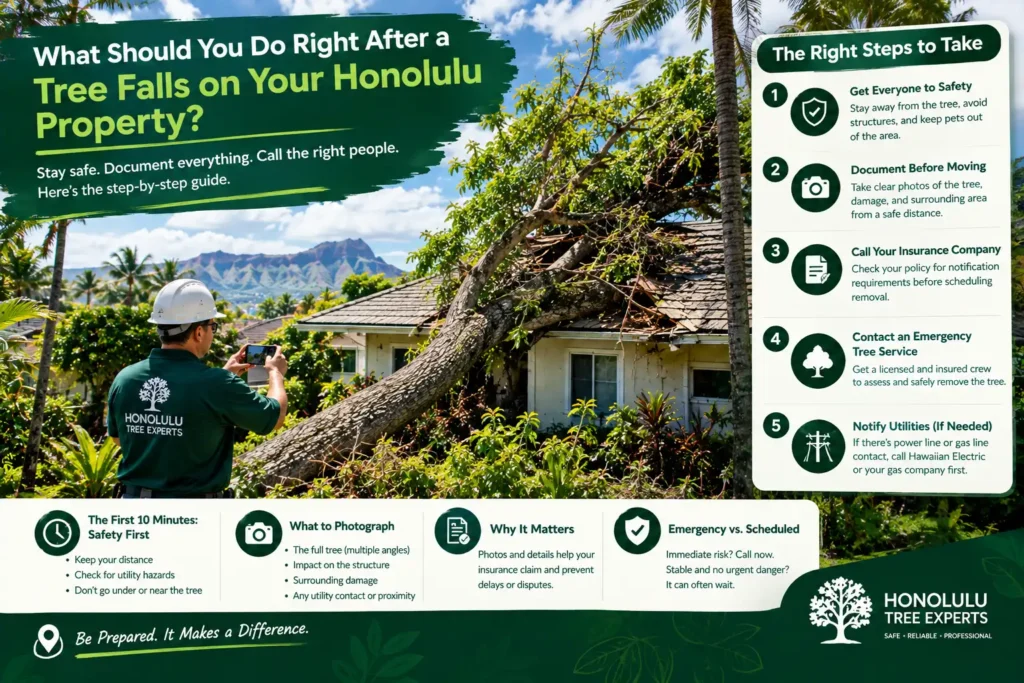
The moment a tree comes down on a Honolulu property, most homeowners do one of two things – they either freeze and don’t know where to start, or they start moving things without thinking through what they’re doing first. Both create problems. What actually needs to happen after a tree falls runs in a specific order – and skipping steps or doing them out of sequence makes the situation worse, not better.
Get everyone away from the affected area first – don’t go under the tree, don’t go into rooms directly below the impact. Once people are clear, document everything with photos before a single branch gets moved. Then call your insurance company if your policy requires notification before removal. Then call the Emergency Tree Service in Honolulu. That last step feels most urgent – but the documentation step is what determines how the insurance claim goes. Skip it and you’re explaining what happened from memory instead of showing it.”
The First 10 Minutes: Safety Before Everything
The instinct after a tree falls is to go look at it. That instinct is wrong. The first ten minutes after a tree comes down on a Honolulu property are about distance, not assessment.
Get everyone away from the affected area — including pets. A tree that’s fallen and is resting against a structure hasn’t finished moving. A roof that’s been partially penetrated by a tree trunk is under load it wasn’t designed for. The section of the structure directly under and around the impact is unstable until a professional has assessed it.
Don’t go into rooms directly below where the tree hit. And Don’t go under a tree that’s resting on a roofline to look at the damage from underneath. Don’t touch or try to move the tree — a tree resting against a structure at an angle is held in place by that contact. Disturbing it without a plan can change where the load goes and cause additional structural damage or injury.
Check for utility hazards from a safe distance. A tree through a roof near an electrical entry point, a tree on a power line, or a tree that’s moved a gas meter — these create hazards beyond the tree itself. If there’s any sign of power line contact or gas line involvement, call Hawaiian Electric or the gas utility before calling a tree service. Emergency tree removal service in Honolulu handles tree work — utility hazards get addressed by the utility first.
Document Before Anything Gets Moved
This is the step most Honolulu homeowners skip — and it’s the step that determines how smoothly the insurance claim goes.
Photos taken before removal starts are the documentation an insurance adjuster needs to evaluate a claim. Once the tree is removed, the evidence of what happened, where the tree was, how it fell, and what it damaged exists only in photos. An adjuster processing a claim without pre-removal documentation is working from description rather than evidence.
What to photograph:
The full tree as it landed — from multiple angles, showing where it came from and where it ended up. The point of impact on the structure — close-up photos showing the contact area before any section of the tree is cut or moved. The surrounding area — showing what else was affect and what the general site condition was at the time. Any utility contact or proximity — documented from a safe distance.
Take these photos from a safe distance. Getting close to the tree or going under it to get better photos isn’t worth the risk. A wide shot from a safe angle is more useful than a close-up taken from an unsafe position.
Downed tree removal in Honolulu starts with the crew assessing the situation — and the homeowner’s photos from before the crew arrived add to the documentation record that supports the insurance claim.
Calling Your Insurance Company
Call your insurance company before scheduling removal if your policy requires prior notification. Some Hawaii homeowner’s insurance policies require the insurer to be notified before significant work begins – scheduling removal first and notifying the insurer after can complicate or delay the claim.
The call doesn’t need to happen before emergency stabilization – if the tree is through the roof and rain is getting in, temporary tarping or stabilization to prevent further damage is reasonable before the insurer calls. What the policy requirement usually means is that the full removal shouldn’t be scheduled and completed before the insurer has had a chance to send an adjuster or give authorization.
When you call, have the photos ready and be prepare to describe:
What caused the tree to fall – storm, wind, visible disease, or unknown. What the tree landed on and what damage is visible. Whether the situation is an active hazard requiring immediate Emergency Tree Service in Honolulu or whether it can be assessed before removal begins.
The insurer will tell you whether they need to send an adjuster before removal starts or whether they can process the claim from documentation. Either way, getting that conversation started early moves the claim forward faster.
When to Call Emergency Tree Service Immediately
Some situations don’t wait for an insurance call or a morning assessment. Emergency Tree Cutting in Honolulu needs to happen immediately when:
The tree is through the roof and rain is actively getting into the structure. Every hour of delay adds water infiltration damage on top of the structural damage the tree caused.
The tree is blocking emergency vehicle access — a driveway that can’t be use or a road that’s block by the fallen tree creates a secondary safety problem.
The tree is in contact with power lines. Call Hawaiian Electric first – HECO handles line contact situations before any tree service crew should be working near them.
The tree is resting against the structure at an angle that’s visibly getting worse – creaking sounds, visible movement, or a position that would worsen in the next wind gust all indicate a situation that needs immediate professional response.
The tree has only partially fallen and is hanging over an occupied area – a trunk cracked partway through that’s still standing but leaning, or a large limb that came down and is resting in the canopy above a living area.
For situations that are hazardous but stable – a tree down in the yard away from structures, a tree that fell cleanly onto a fence – Emergency Tree Service in Honolulu can be scheduled for first thing the following morning rather than overnight, which saves the after-hours premium.
Tree on a Roof: Specific Steps
A tree through or on a roof is the most common serious emergency on Honolulu residential properties after a major storm. The steps are specific to this situation.
Get everyone out of the rooms directly below the impact and keep them out until a professional has assessed the structural situation. The roof is under load it wasn’t designed for and the ceiling below the impact point may be compromised.
Temporary tarping to prevent water infiltration is appropriate while waiting for the removal crew – but don’t get on the roof to tarp around a tree that’s still resting on it. Ground-level tarping of any openings at the eaves or wall level that are accessible safely is the limit of what should happen before the crew arrives.
The removal sequence on a tree through a roof matters significantly. Sections have to come off the tree in an order that reduces load on the roof progressively rather than shifting load suddenly. Tree and limb removal in Honolulu on a roof job requires crane equipment in many cases – lifting sections clear rather than letting them fall through the already-compromised roof structure.
Don’t try to cut sections of the tree yourself. The tree is under tension in ways that aren’t obvious from the outside – a cut in the wrong place releases that tension in a way that can cause the tree to shift suddenly and do additional damage to the structure below it.
Tree on a Car
A tree on a vehicle is a property damage situation rather than a structural hazard – which changes the sequence slightly.
Document with photos immediately — the position of the tree, the contact points with the vehicle, and any surrounding damage. This documentation supports both the homeowner’s insurance claim and any claim against the vehicle insurance.
Don’t try to drive the vehicle out from under the tree. The tree may be holding weight that’s resting on the vehicle — removing the vehicle without first removing the tree sections resting on it can cause those sections to drop suddenly.
Call the insurance company before scheduling removal if the vehicle is the primary damage — auto insurance handles vehicle damage, homeowner’s insurance handles property damage if the tree also hits a structure.
Tree limb removal in Honolulu on a vehicle situation usually doesn’t require crane equipment unless the tree is very large. A crew with the right sectioning approach can remove the tree from the vehicle without adding to the damage — but the approach matters, and a crew that understands how to sequence the cuts around a vehicle is different from one that just starts cutting.
What Not to Do After a Tree Falls in Honolulu
Don’t start cleanup before documenting. Every branch moved, every section cut, every piece of debris cleared before photos are taken is evidence that’s gone from the insurance claim. Document first, clean up after.
Don’t accept a verbal quote from a door-to-door crew. Storm events bring unlicensed crews canvassing Honolulu neighborhoods offering cheap emergency rates. These crews often don’t carry proper insurance, don’t follow safe removal techniques, and aren’t reachable if something goes wrong during the job. Removing a tree in Honolulu with a crew that isn’t licensed and insured leaves the homeowner exposed for any additional damage that happens during the job.
Don’t sign anything before reading it. Some emergency service companies use the urgency of the situation to get signatures on contracts with terms the homeowner wouldn’t agree to otherwise. A legitimate Emergency Tree Service in Honolulu provides a written quote before work starts — not a contract signed in the dark with a flashlight.
Don’t delay calling the insurance company. Many policies have notification windows — waiting several days before reporting a claim can create complications that wouldn’t exist with a same-day call.
Don’t leave the tree in place longer than necessary if it’s on a structure. Every hour a tree rests on a roof or wall adds potential moisture infiltration and structural stress. The urgency of removing a tree from a structure is real — it’s not just about the appearance of the property.
After the Tree Is Removed
Once the emergency tree removal is complete, a few things happen next.
The structure gets assessed by a contractor for damage scope. The tree removal crew can tell you what they saw on the roof during removal — but a licensed contractor or structural engineer assesses what the removal revealed and what repairs are needed.
Care Tree Service in Honolulu on the remaining trees on the property makes sense in the days following a storm event. A storm that brought one tree down often stressed neighboring trees in ways that show up on close inspection — new leans, opened cracks, root zone disturbance. An arborist assessment of the remaining trees after the emergency is handled catches those problems while options still exist.
The stump from the removed tree can usually wait — it’s not an urgent situation in the way the tree removal was. Scheduling Tree Removal Honolulu with stump grinding on a follow-up visit, or bundling it with the initial removal if the crew is still on site, gets the root system below grade before it becomes a termite attraction or a trip hazard.
Document the completed removal — photos of the cleared area, the roof condition after removal, and any visible damage that the removal revealed. This documentation adds to the insurance claim record and establishes the baseline condition of the property after the event.
FAQs Tree Down on Your Honolulu Property
Q1: What’s the first thing to do when a tree falls on my house in Honolulu?
Get everyone out of the affected area — the rooms directly below the impact and any area under the tree that’s still resting on the structure. Keep people and pets away until a professional has assessed the structural situation. Then document with photos from a safe distance before calling Emergency Tree Service in Honolulu or your insurance company.
Q2: Do I need to call my insurance company before getting the tree removed?
Check your policy first. Some Hawaii homeowner’s insurance policies require prior notification before major work begins. A quick call to your insurer before scheduling removal — even if it’s just leaving a message — protects the claim. Emergency stabilization to prevent further damage is generally acceptable before the insurer calls.
Q3: How long can I leave a tree on my roof before it causes more damage?
Every hour adds potential water infiltration and structural stress. A tree on a roof isn’t a situation that improves with time — rain getting into an opening around the tree adds moisture damage on top of structural damage. Emergency tree removal service in Honolulu on a tree through a roof should happen as soon as a crew can safely get there.
Q4: Can I cut the tree myself to remove it from my car or fence?
In most cases, no. A tree resting on a structure or vehicle is under tension that isn’t obvious from the outside. A cut in the wrong place releases that tension suddenly — causing the tree to shift in ways that can do additional damage or create injury risk. Removing a tree in Honolulu with a professional crew that knows how to sequence the cuts is significantly safer than DIY extraction.
Q5: What documentation do I need for an insurance claim after a tree falls?
Photos of the tree as it landed from multiple angles, photos of the impact area before any removal starts, photos of any utility contact or proximity, and a written itemized invoice from a licensed removal company. The pre-removal photos are the most critical — once the tree is removed, the visual evidence of what happened exists only in those photos.
Q6: Does emergency tree removal include cleanup?
It should. A legitimate Emergency Tree Service in Honolulu includes debris processing and site clearing before the crew leaves. Ask specifically when getting a quote — some emergency quotes cover cutting only, leaving the homeowner to arrange separate cleanup. A full-service quote covers cutting, chipping or hauling, and site clearing as a single job.
Q7: What happens to the stump after emergency tree removal?
The stump usually stays in the ground after emergency removal — grinding it is a separate operation that doesn’t need to happen the same day. Downed tree removal in Honolulu that includes stump grinding on the same visit costs less than booking it as a separate job later. Ask the crew when they’re on site whether bundling it makes sense given the equipment they have with them.