
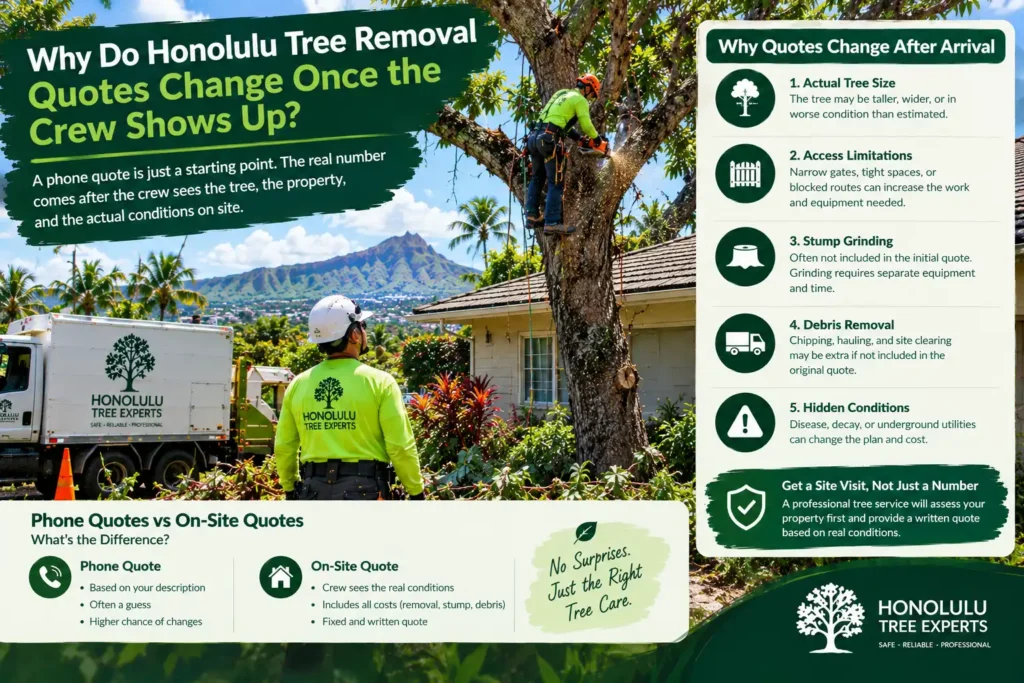
It happens often enough that most Honolulu homeowners have either experienced it or heard about it from a neighbor. A quote comes in at one number. The crew shows up, looks at the tree, and the number goes up. Sometimes significantly. Understanding why this happens — and what separates a legitimate revision from a bait-and-switch — is worth knowing before the crew arrives.
Honolulu tree removal quotes change after the crew arrives for a few legitimate reasons — the phone quote missed the actual access situation, stump grinding wasn’t included in the base quote, debris removal was excluded to keep the number low, or the tree revealed a condition on arrival that wasn’t visible from a description. Quotes that change for illegitimate reasons — a crew that always finds a reason to revise upward — are a different problem. Knowing the difference protects the homeowner before signing anything.
Why Phone Quotes Are Guesses
A tree removal quote given over the phone is a starting range at best. The crew hasn’t seen the tree, the access conditions, what’s underneath it, or what’s around it. Every one of those factors affects the actual job.
A homeowner describes a large tree in the backyard. The crew quotes based on that description. What the crew finds when they arrive: the tree is 80 feet tall rather than the 60 the homeowner estimated, the backyard gate is 30 inches wide and the stump grinder doesn’t fit through it, there’s an irrigation line running directly under the root zone that needs to be worked around, and the trunk has visible fungal growth at the base that indicates internal decay — which changes how the tree behaves when it’s cut.
None of these things were in the phone description. All of them affect the quote. A legitimate upward revision after a site visit reflects real conditions the phone call couldn’t capture. Honolulu tree removal that starts with an on-site assessment before any number gets committed eliminates most of these surprises.
Phone Quotes vs On-Site Quotes: The Difference
The gap between a phone quote and an on-site quote tells a homeowner something about how the company operates.
A company that gives a firm number over the phone without seeing the property is setting a number it will likely revise upward. The revision happens either before work starts — when the crew arrives and does the assessment — or after, on the invoice. Neither outcome is good for the homeowner.
A company that gives a range over the phone and schedules an on-site assessment before committing to a number is operating correctly. The range gives the homeowner a realistic expectation. The on-site assessment produces the actual quote. That quote, confirmed in writing, is the number that should be on the invoice.
Honolulu tree removal that starts with a site visit produces a quote the crew stands behind. Tree removal honolulu hi homeowners who’ve dealt with quote changes after arrival have almost always been dealing with companies that skipped the site visit.
Stump Grinding: The Most Common Add-On
The single most common reason a Honolulu tree removal quote goes up after the crew arrives is stump grinding. Most base quotes for tree removal don’t include it — and most homeowners don’t realize it until they see the stump sitting in the yard after the crew leaves.
Stump grinding is a separate operation that requires separate equipment. The stump grinder may or may not be on the same truck as the removal equipment. On jobs where it’s bundled, both happen in the same visit. On jobs where it’s quoted separately, the homeowner either pays the add-on price when the crew is on site or schedules a second visit.
Tree stub removal in Honolulu is almost always less expensive when bundled with the initial removal than when booked as a standalone job. The equipment is already on site. The crew is already working. Adding the stump grind at the end of the removal costs less than a second mobilization.
The fix is simple: ask specifically whether stump grinding is included in the quote before agreeing to anything. If it’s not, ask for the bundled price. A crew that won’t give a stump grinding price until they’re on site is a crew that may be holding it as leverage once the tree is already cut.
Tree Stump Removal in Honolulu quoted upfront and included in the written agreement prevents this specific surprise from appearing on the invoice.
Debris Removal: What’s Actually Included
The second most common quote discrepancy in Honolulu tree removal is debris removal. A base quote covers cutting the tree down. What happens to the pieces afterward isn’t always in that number.
Debris removal has three possible outcomes: the crew chips branches on site and hauls the chips, the crew cuts trunk sections into manageable pieces and loads them out, or the crew leaves everything on the ground and the homeowner arranges separate disposal. The first two cost more than the third — and a quote that excludes debris removal to look cheaper will produce a yard full of wood that needs to be dealt with separately.
Tree and brush removal in Honolulu quotes that look unusually low often exclude debris handling entirely. The job looks cheaper on paper until the homeowner realizes the quote was for cutting only. The actual full-service cost — cutting, chipping, hauling, and site clearing — runs higher.
What to ask: Does the quote include chipping branches? Does it include hauling trunk sections? Does it include raking and clearing the site before the crew leaves? A yes to all three is a full-service quote. A no to any of them means there’s more cost to come.
Tree limb removal in Honolulu — particularly on large canopy trees that produce significant limb volume — adds debris handling time that sometimes gets excluded from base quotes to keep the initial number competitive. Getting the full scope confirmed in writing before work starts is the only reliable protection.
Permit Costs: Who Pays and Who Handles It
Some trees in Honolulu require city approval before removal. Protected species, large canopy trees in certain residential zones, trees near shorelines — these trigger permit requirements under Honolulu’s Urban Forestry program.
A quote that doesn’t address permit requirements is a quote that may change when the crew arrives and discovers a permit is needed. The permitting process takes time — and a job that gets started without the required permit puts the violation on the homeowner’s property record.
Oak tree removal in Honolulu frequently triggers a permit check — oak is a species where size and location determine whether city approval is required. A crew that checks permit requirements before quoting includes any permit costs and timeline in the initial quote. A crew that skips this check discovers the requirement on arrival — which delays the job and potentially changes the cost.
Legitimate tree removal companies in Honolulu check permit requirements during the on-site assessment and include any permit costs in the written quote. The homeowner knows the full cost before work begins — not after a delay that could have been anticipated.
Trunk and Stump Conditions Discovered on Arrival
A tree that looks straightforward from a description can reveal conditions on arrival that change the job.
Tree trunk removal in Honolulu on a tree with internal decay behaves differently than removal of a structurally sound trunk. Decay creates unpredictable split patterns under the chainsaw — the crew has to work more carefully, take smaller sections, and spend more time on assessment before each cut. Jobs with significant internal decay take longer and cost more than the same size tree in sound condition.
Tree fungus removal in Honolulu is sometimes a separate line item when fungal growth at the base or trunk indicates extensive decay that wasn’t visible from a phone description. An experienced crew identifies this on arrival — but a crew that gave a firm phone quote is now in the position of either absorbing the additional work cost or revising the quote. The homeowner finds out which approach the company takes at exactly this moment.
This is why the on-site assessment before quoting matters specifically for older trees, trees showing any external signs of stress, and trees near the end of their natural lifespan. The conditions that cause quote revisions are visible on inspection — they’re just not visible over the phone.
How to Get a Quote That Doesn’t Change
The homeowner’s side of preventing quote surprises is straightforward.
Require an on-site assessment before any number is committed. Any Honolulu tree removal company that won’t visit the property before quoting is operating in a way that almost guarantees a quote revision.
Get the quote in writing with a specific scope. The written quote should specify: tree removal, debris handling method. And stump grinding yes or no and at what price, permit check completed, and cleanup included. A quote that specifies all of these doesn’t have room for later additions.
Ask specifically about stump grinding. “Is stump grinding included?” is the question that prevents the most common post-arrival surprise in Honolulu tree removal.
Ask about debris disposal. “Does this quote include hauling away all debris?” gets a yes or no that clarifies what’s actually in the number.
Ask whether a permit check has been done. “Did you check whether this tree requires a permit?” confirms that the crew has completed this step and any permit costs are in the quote.
Residential Tree Service in Honolulu from a licensed, ISA-certified company produces written quotes that cover all of these items before work begins. The number on the quote is the number on the invoice — not a starting point for negotiation after the tree is already cut.
FAQs Tree Removal Quote Changes in Honolulu
Q1: Why did my Honolulu tree removal quote change after the crew arrived?
The most common reasons are stump grinding wasn’t in the base quote, debris removal was excluded, the tree was larger or more complex than the phone description suggested, or the crew found internal decay or fungal growth that changes how the job needs to be done. Legitimate revisions reflect real conditions. Revisions that consistently appear after the crew arrives regardless of the tree are a sign of a company that uses phone quotes to get the job and revises upward on arrival.
Q2: How do I prevent a Honolulu tree removal quote from changing?
Get the on-site assessment done before any number is agreed to. Get the quote in writing with a specific scope that includes stump grinding, debris removal, permit status, and cleanup. A written quote with a defined scope has no room for additions after the fact.
Q3: Is stump grinding always extra in Honolulu tree removal quotes?
Not always, but it’s excluded from base quotes often enough that it should be confirmed specifically before agreeing to any price. Tree Stump Removal in Honolulu bundled with the removal visit costs less than a separate booking. Ask for the bundled price when getting the initial quote.
Q4: What does tree fungus at the base mean for the removal cost?
Tree fungus removal in Honolulu situations — where fungal growth at the base indicates internal decay — add time and complexity to the removal. Decay changes how the trunk behaves under the saw and requires more careful sectioning. A crew that identifies this on arrival has a legitimate basis for revising a phone quote. A crew that checked the tree during an on-site assessment would have included this in the original quote.
Q5: Does tree removal in Honolulu always include debris cleanup?
No, not automatically. Some quotes cover cutting only. Full-service quotes include chipping branches, hauling trunk sections, and clearing the site. Tree and brush removal in Honolulu quotes should specify exactly what debris handling is included. If the quote doesn’t address it, ask before work starts.
Q6: What should a complete Honolulu tree removal quote include?
Tree removal, debris handling method and whether hauling is included, stump grinding at a specified price, confirmation that permit requirements have been checked, and site cleanup before the crew leaves. A quote that specifies all of these is a complete quote. Anything missing is a potential add-on after arrival.
Q7: Does Honolulu Tree Expert’s quote change after the crew arrives?
No. Every Honolulu tree removal job starts with a free on-site assessment. The arborist walks the property, checks the tree, assesses access and stump condition, confirms permit requirements, and gives a written quote that covers the complete scope. That number is the number on the invoice — the price you hear on-site is the price you pay.