
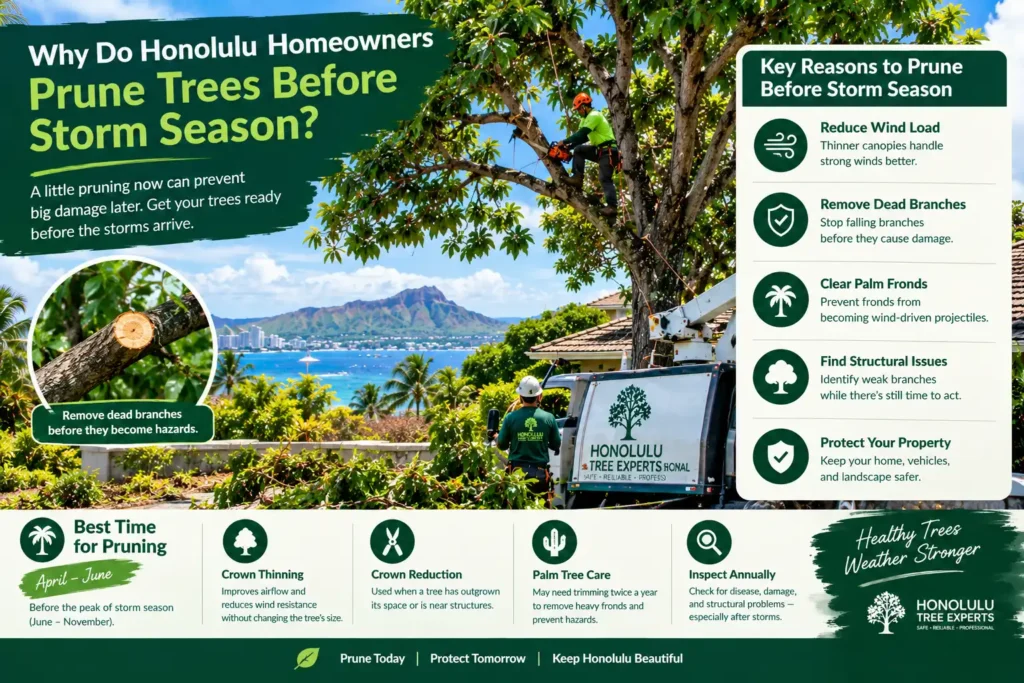
Most Honolulu homeowners who’ve dealt with storm damage once don’t wait to deal with it again. A branch through a roofline or a palm frond across a car changes how seriously a property gets prepared the following year. Pruning trees in Honolulu before storm season is the single most consistent thing homeowners do differently after their first significant storm event – because it’s the intervention that actually changes what a storm does to a property.
Honolulu homeowners prune trees before storm season to reduce wind load on canopies and root systems, remove dead branches that become projectiles in high wind, clear palm fronds that catch wind like sails, and identify structural problems while there’s still time to address them on a schedule rather than as an emergency. A pruned tree handles Honolulu storm season differently than an unpruned one – and that difference shows up in what’s left standing when the storm passes.
What Storm Season Actually Does to Unpruned Trees
Honolulu storm season runs June through November with peak activity between August and October. What that period does to an unpruned tree on an Oahu property is specific and predictable.
An untrimmed canopy catches wind as a solid surface. Trade winds that blow predictably from the northeast shift direction during storm events – hitting surfaces of the tree that spent the whole year sheltered. An untrimmed palm crown loaded with dead fronds and two seasons of overgrowth becomes a sail in exactly the conditions where the root system in saturated volcanic soil is least able to hold.
Dead branches sit in canopies all year without falling – until sustained wind gives them a reason to move. A branch that is held in place through ten trade wind events can dislodge in the first strong storm gust and land on whatever is underneath it. Pruning a tree in Honolulu before storm season removes those branches while the crew controls where they go – not during a storm when they go wherever the wind sends them.
Root systems in Oahu’s volcanic soil spread wide and shallow. They handle the consistent load of a balanced canopy in normal conditions. A storm adds dynamic wind load to a canopy that may have grown heavier and more asymmetric since the last time anyone looked at it. Pruning addresses that load before the storm applies it.
Dead Branch Removal: The Clearest Pre-Storm Priority
Dead branches in the upper canopy are the most immediate pre-storm concern on most Honolulu residential properties. They’re already at failure – they’re sitting in the tree held in place by surrounding growth or wedged in a fork rather than attached to the trunk. One wind event is all it takes to dislodge them.
The problem with dead upper canopy branches is that they’re not obvious from ground level. A dead branch resting in the fork of a live branch looks like a live branch from the yard. Getting close to it – or having an arborist who knows what to look for — is the only way to identify it before it becomes a falling hazard.
Pruning a tree in Honolulu before storm season specifically targets this material. Dead branches come out while the crew controls the drop. The same branches removed by storm winds land on rooflines, vehicles, and people without that control.
A property with multiple large trees going into storm season without a dead branch check is carrying risk that a single pre-storm visit eliminates. Tree pruning and removal in Honolulu on trees where the dead material is too extensive to manage with pruning alone identifies those situations before storm season rather than after.
Crown Weight Reduction: How It Changes Wind Load
A heavy, dense canopy handles wind differently than a pruned one. The physics are straightforward – more surface area catches more wind force, and that force transfers into the trunk and root system. A root system already sitting in saturated ground after days of storm rain has real limits on what it can anchor.
Crown weight reduction through pruning trees in Honolulu removes the branches contributing most to asymmetric loading – branches that have grown heavier on one side than the other, creating a lean in wind that a balanced crown wouldn’t create. It thins interior density so wind passes through the canopy rather than hitting it as a wall. And it removes growth that’s outpaced the structural strength of the branch attachment.
The difference in how a pruned canopy handles storm conditions versus an unpruned one is real and measurable. A tree pruning company in Honolulu that works on properties before and after storm season sees this directly – the trees that went through pre-storm pruning and the ones that didn’t produce very different post-storm outcomes on adjacent properties.
What tree pruning honolulu does to wind load isn’t a subtle improvement. On large canopy species – monkeypod, mango, avocado – the difference between a thinned crown and an unthinned one in a sustained wind event can be the difference between a tree that holds and one that shifts at the root zone.
Palm Frond Management Before Storm Season
Palm tree pruning in Honolulu is the most common pre-storm pruning job on Oahu residential properties — because palms are everywhere and because untrimmed palms create specific, predictable storm problems.
Dead fronds add weight to the crown without contributing structural value. A palm crown loaded with dead fronds going into storm season is heavier than it needs to be and has more material that can catch and direct wind. Live fronds that haven’t been thinned create more surface area for wind to push against — the crown acts like a sail rather than moving with the wind.
The load transfers straight down into the root system. A palm in Oahu’s volcanic soil with a wide, shallow root system handles that load fine in normal conditions. Add storm wind, saturated soil, and a crown carrying two seasons of untrimmed growth, and the root system’s grip changes materially.
Palm tree pruning in Honolulu before storm season removes dead fronds and reduces live frond load on species where thinning makes sense. The result is a palm that moves with wind rather than catching it — which is what palms are actually designed to do when they’re maintained correctly.
The timing matters. Pruning palms too close to storm season doesn’t leave enough time for the crown to stabilize before the most active storm months. April through June is the window where pre-storm palm pruning produces the best outcomes on Oahu properties – done before peak season rather than as it arrives.
Oak and Hardwood Species: Species-Specific Pre-Storm Pruning
Oak tree pruning in Honolulu follows different rules than palm or tropical species pruning. Oaks are sensitive to cut timing and technique – wrong cuts create entry points for disease that spread into structural wood. Pre-storm pruning on oaks needs to happen with enough lead time for pruning wounds to begin closing before storm season stress is added.
Oaks benefit from pre-storm pruning that specifically targets dead wood, crossing branches, and anything developing at a narrow attachment angle. Narrow angles develop including bark – a weak union that splits under load. A storm that a properly attached branch handles easily can split a narrow-angle branch at the attachment point. Identifying and removing those attachments before storm season changes what the storm does to an oak’s canopy.
Dense hardwood species like monkeypod and large mango also benefit from pre-storm crown thinning. These species develop heavy canopies fast in Oahu’s climate – a canopy that was appropriately balanced a year ago may have added significant weight since then. A tree pruning company in honolulu assessment before storm season catches this weight shift and addresses it while the tree is still in the ground rather than after it’s on the roof.
When Pre-Storm Pruning Reveals a Removal Need
Pre-storm pruning visits regularly uncover situations where pruning isn’t enough. A dead branch that looks like a pruning candidate from the yard turns out to be a sign of internal decay running through the trunk. A palm targeted for frond removal shows signs of Coconut Rhinoceros Beetle damage or Fusarium wilt that changes the recommendation from pruning to removal.
Tree pruning and removal in Honolulu handled together on the same pre-storm visit is more efficient than separate bookings. The arborist assesses the full property, identifies what can be managed with pruning and what needs to come down, and the crew handles both in one mobilization.
The trees identified as removal candidates during a pre-storm assessment represent exactly the risk that pre-storm preparation exists to address. A tree that gets removed before storm season at standard rates costs a fraction of what it costs as an emergency removal after it falls during a storm — and nothing compared to the structural damage repair that follows when a large tree comes down on a house.
Care Tree Service in Honolulu that includes pre-storm assessment and pruning as part of a regular maintenance schedule catches these situations consistently. Properties on a regular maintenance schedule rarely face the kind of emergency events that first-time pre-storm pruning visits uncover — because the problems get caught and addressed every year before they reach the emergency stage.
What a Pre-Storm Pruning Visit Actually Covers
A pre-storm pruning visit from tree pruning companies in Honolulu worth hiring covers more than just cutting branches. The arborist walks the property and assesses every tree — not just the ones the homeowner flagged.
Dead upper canopy material gets identified and removed. Crown weight and balance get evaluated relative to the root system and what’s near the tree. Palm frond loads get assessed and reduced. Root zones get checked for disturbance or new movement that developed since the last visit. Disease signs — Phytophthora at the root flare, Fusarium frond death patterns, beetle bore holes — get caught if they’re there.
The visit produces specific recommendations — prune this, remove that, monitor this one and reassess after storm season. It ends with the property in better condition to handle what storm season brings than it was before the crew arrived.
Honolulu Tree Trimming visits that combine trimming and pruning in the same pre-storm window address the full range of canopy management needs rather than targeting only one type of work. The trees that need thinning get thinned. The ones that need dead wood removed get that. Palms get fronds cleared. The property goes into storm season with every tree in the best condition possible given what it’s working with.
FAQs Tree Pruning Before Storm Season in Honolulu
Q1: When should trees be pruned before storm season in Honolulu?
April through June is the optimal window for most species. This gives enough time for pruning wounds to begin closing before peak storm activity in August through October, and it addresses canopy weight and dead branch load before the most active storm months arrive. Pruning trees in Honolulu too close to peak season — in July or August — doesn’t leave enough recovery time before the highest-risk period.
Q2: Does palm tree pruning actually help in a Honolulu storm?
Yes. A trimmed palm moves with wind rather than catching it. Dead fronds add weight without strength. Live fronds that haven’t been thinned create more wind surface area. Palm tree pruning in Honolulu before storm season reduces both — the crown gets lighter and more aerodynamic before the conditions that test it arrive.
Q3: What’s the difference between pruning for storm preparation and regular pruning?
Storm prep pruning specifically targets dead upper canopy branches, crown weight reduction, and wind load management. Regular pruning manages overall tree health, crossing branches, and canopy density. Pre-storm pruning often includes both — a good tree pruning company in Honolulu handles the health work and the storm prep work in the same visit rather than treating them as separate jobs.
Q4: How do I know if my oak tree needs pre-storm pruning?
Signs include dead branches in the upper canopy, branches attached at narrow angles to the trunk, crossing limbs that rub against each other, and canopy weight concentrated heavily on one side. Oak tree pruning in Honolulu before storm season specifically addresses these structural weaknesses before storm winds apply load to them.
Q5: What happens if I skip pre-storm pruning in Honolulu?
The unpruned tree goes into storm season carrying whatever dead branches, canopy weight, and structural issues it had before the season started. Those issues don’t improve with time — they get tested by the first storm event that’s significant enough to apply load to them. Emergency Tree Service in Honolulu after a storm costs 20% to 50% more than pre-storm scheduled work, and it doesn’t address the structural damage that follows when a tree or branch fails.
Q6: Should I prune or remove a tree that’s already leaning before storm season?
Get a professional assessment before making that call. A lean that’s been stable for years is different from one that developed or worsened recently. A stable lean in a tree with a sound root system may be manageable with crown weight reduction on the heavy side. A lean that’s gotten worse recently indicates root zone movement — Tree Removal Honolulu is often the more appropriate response than pruning.
Q7: Does Honolulu Tree Expert do pre-storm pruning assessments?
Yes. Honolulu Tree Expert sends an ISA-certified arborist to walk the property before storm season — every tree gets assessed, dead branch load gets identified, canopy weight gets evaluated, and palm frond loads get reviewed. Tree pruning honolulu that starts with a full property assessment rather than just addressing the one tree the homeowner called about catches the full range of pre-storm risk on the property.